System Center Configuration Manager connector
 |
|  |
| 
The System Center Configuration Manager (SCCM) connector connects to a Configuration Manager database and pulls inventory and usage data.
Prerequisites
Before adding this connector, ensure the following:
-
Configuration Manager client settings are enabled. Refer to Configuration Manager site configuration.
-
Configuration Manager database access is granted to one of the following, with the required database rights (detailed below):
-
Tachyon Server's Network Service (computer$) account.
-
An SQL Login in the Configuration Manager database.
-
This connector supports both SCCM and Microsoft Endpoint Configuration Manager (MECM).
Configuration Manager site configuration
To gather inventory and usage data from clients, the following Client Settings must be configured and applied to relevant Collections containing in-scope devices:
-
Software metering. (Metering rules are not necessary).
-
Software inventory.
-
Hardware inventory.
To gather Active Directory data about clients, the following Discovery Methods must be configured and applied to relevant Domains and OUs containing in-scope devices:
-
Active Directory System Group Discovery. (Default attributes are sufficient).
Adding the connector
-
Navigate to Settings > Configuration > Connectors.
-
Click Add.
-
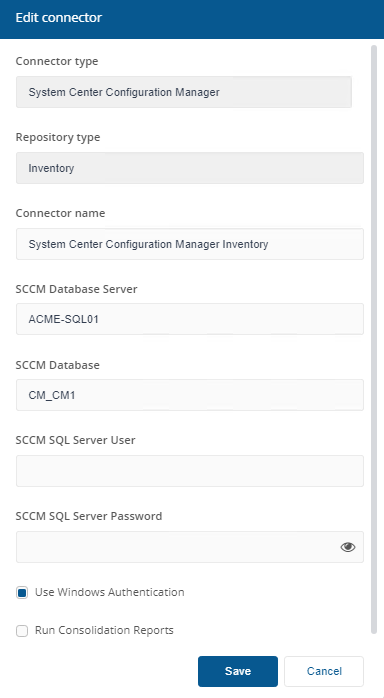
In the Add Connector pop-up window, select System Center Configuration Manager as the connector type.
-
In Connector name, enter a logical name for this connector.
Use a naming convention for connector names, for example, <connector type> <scope> <RCR>. Scope describes where data is coming from or what it's being used for, for example, Demo, Test, Lab, Q2 Audit. Include RCR in the name if the Run Consolidation Reports option is available and you have enabled it.
-
In SCCM Database Server, enter the name of the SQL Server instance where the Configuration Manager database is hosted, including custom port if used. In our example, this is ACME-SQL01.
The SQL Server instance should be specified using one of the following formats:
-
<Server Name>
-
<Server Name>\<Instance> (For a named instance)
-
<Server Name>\<Instance>,Port (For a custom port)
-
-
In SCCM Database, enter the name of the Configuration Manager database you want to connect to. In our example, this is called CM_CM1.
-
If you are authenticating with Windows, note the following:
-
Ensure the Use Windows Authentication checkbox is selected.
-
You do not need to populate the SCCM SQL Server User and SCCM SQL Server Password fields.
If you are using an SQL account, note the following:
-
Ensure the Use Windows Authentication checkbox is not selected.
-
In SCCM SQL Server User, enter the name for the account you want to use to connect to the database.
-
In SCCM SQL Server Password, enter the password associated with this account.
If the Use Windows Authentication checkbox is selected, the SQL Server User and SQL Server Password fields are ignored. With Windows authentication, the connector is using the SLA Platform Integrate Agent service account. This service is configured to use Network Service, which is the 1E server's computer$ account on a remote server.
-
-
Select the Run Consolidation Reports checkbox if you want consolidation actions to be processed each time the Sync Data action is executed for the connector.
If you enable this on more than one connector, it can lead to unnecessary processing. The recommended method of processing consolidation actions is to schedule the action Generate Report - Basic Inventory Consolidation to execute after the Sync Data actions have run for all connectors. This will execute the remaining consolidation actions. Alternatively, select the Run Consolidation Reports checkbox on one of your connectors. You can view action processes in Settings > Process log.
-
Click Add.
For information on how to test or delete a connector, and how to sync data into a repository, refer to Connectors page.